

…and 7 simple steps to help you get started
I was once the narrator in a school play about Jonah and the Whale. I was deeply disappointed not to have a starring role. I didn’t get to have a robe and head dress and instead I wore my jeans and favourite leg warmers. It really wasn’t the same. I didn’t get to strut purposefully about the stage. I had to stay in the corner, at my little podium. My acting dreams were crushed.
It wasn’t until the actual performance was underway that my 8 year old brain realised, too late to enjoy it, that the narrator was actually the top spot. I got to stay on stage the whole time and actually tell the story. It was the storytelling that gave the acting context.
It is our stories that connect us to our audience and it is that connection that helps us feel empathy, create communities and embed culture. On top of that, business storytelling has some tangible bottom line benefits, ultimately leading to sales, to staff retention, to brand recognition…to a whole heap of things that we want.

Dr Murray Nossel from Columbia University tells us that, “the quality of connection that results from storytelling is deeper, more lasting, more resonant, and therefore qualitatively more powerful than other means of communication.”
Nossel goes on to say, “Whether you’re talking about sales or marketing, human resources, or content-generation, your ultimate success depends heavily on your connection with an audience…stories touch people …primarily on an experiential and emotional level. And we know that’s where change occurs. That connection-point is where true transformation takes place”.
In very basic terms a great story well told = business happiness.
Now knowing this is one thing, but to tell a good story, a story that really connects, well that is something very different indeed.
So how do you tell a story that your audience, whoever they may be, can connect with?
Visually of course.
Whaaaaat?!
If you were already feeling the pressure about how important storytelling is then why on earth add visuals into the mix? I mean really, it is just
too
much.
But stay with me…
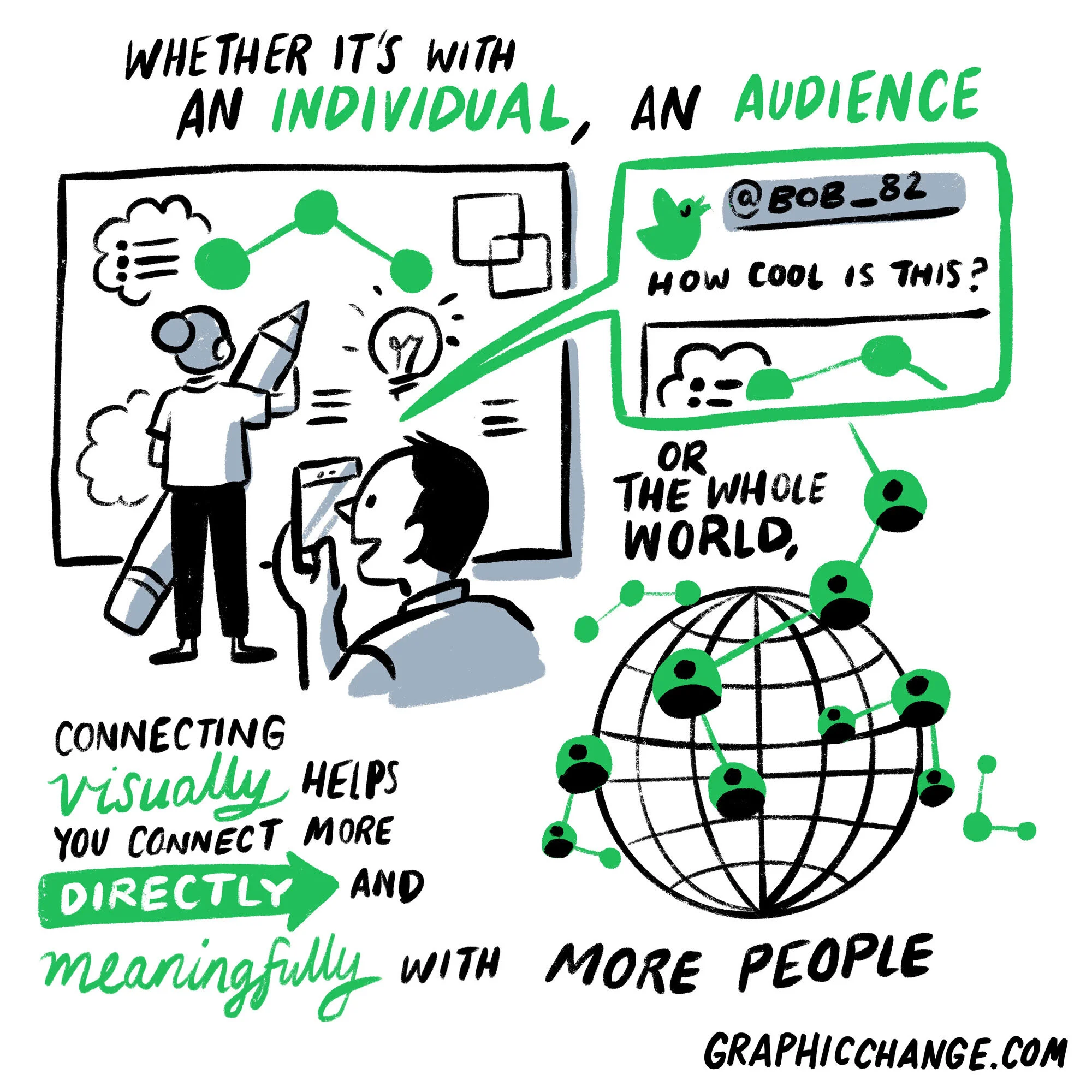
We’ve been helping businesses tell their valuable stories for years. We even run a course called Visual Storytelling, and I promise you, your business stories are a Super Power when it comes to growing a following, building a workplace culture or connecting with customers. So if you are going to tell your stories, and have them resonate and connect, then you need to tell stories in the most effective way you can, and that my friend, needs visuals.
“There is power and magic – real magic – in visualising and telling your story.”
We humans are natural visual communicators. You are brilliantly able to decipher and remember visuals. In fact, as far back as the mid-seventies, research showed us that using pictures and words together can improve information recall by 6 times.
If it’s so good, you might be thinking, then why isn’t everyone doing it? Well, if you didn’t have your confidence crushed by ‘failing’ in art class, then societally, I’m afraid to say, we are still educated to equate text with work and pictures with…well, childishness. We quite simply fall out of practise.
Here are 7 easy steps to help you start visualising your business stories, big and small:
1. Record it
Keep a notebook or start a file of your business stories. They might be big, like founder or product origin stories, they might be small but important AHA! moment stories, they might be tiny moments or habits that demonstrate your business culture. Ask your colleagues to add their stories, too. This file of memories, anecdotes and office tales are your Story Depository.
2. Sort it
Sort through your Depository and categorise your stories. The categories you use are totally up to you. Here are some suggestions to inspire you:
- Origin / founder story
- Product or service origin
- Customer journey
- Customer transformation (due to your offer)
- Case studies
- Memorable moments
3. Sketch it
Grab some scrap paper, or if you’re a stationery geek, a beautiful blank or dot grid notebook.
Grab a black felt tip pen and a couple of highlighter pens. Now start to sketch out your story. This is your rough version. Think about what is important to include and what you can leave out. Don’t worry about your artistic skills or making mistakes. Stick people are totally fine. Just focus on getting the steps of the story down on paper.
4. Structure it
Make sure your page is organised in a way that makes sense. You want your audience to know where to look first and then how to move around the page. This is called the Flow. To help your Flow be easy to follow you could number the steps of your story, or use a line to connect one step to the next.
5. Test it
Now it’s time to test your story on some real people. Does it make sense? Have you missed anything? What does it make them feel? Make some notes and tweak your story.
6. Style it
Now it’s time to get into the detail and, using your rough picture as a reference, start on a more polished version to share. Think about the feel of your business: is it playful and fresh, is it natural and artisinal? Think of each step of your story in see if you can make each of your visuals reflect your business personality. Think of your business colours and use them with a light touch.

7. Share it
Now it’s time to share! Scan it or photograph it in good light and share it with your people.
This is, of course, just part of the story. There are heaps of different ways to use storytelling in your business, so here are some more storytelling resources you might find useful:
Visual Storytelling course:
A self led, online course with 24/7 access to lessons, and tutor support to answer your questions. 7 practical methods to apply to your work environment. Take it solo, or train up your team. Click here to find out more.
Let us do it for you:
If you’re struggling to visualise your critical stories then we can help by coaching or by producing visual assets for you. Get in touch to talk about the stories you want to tell.